


What should be included on a UK VAT invoice?

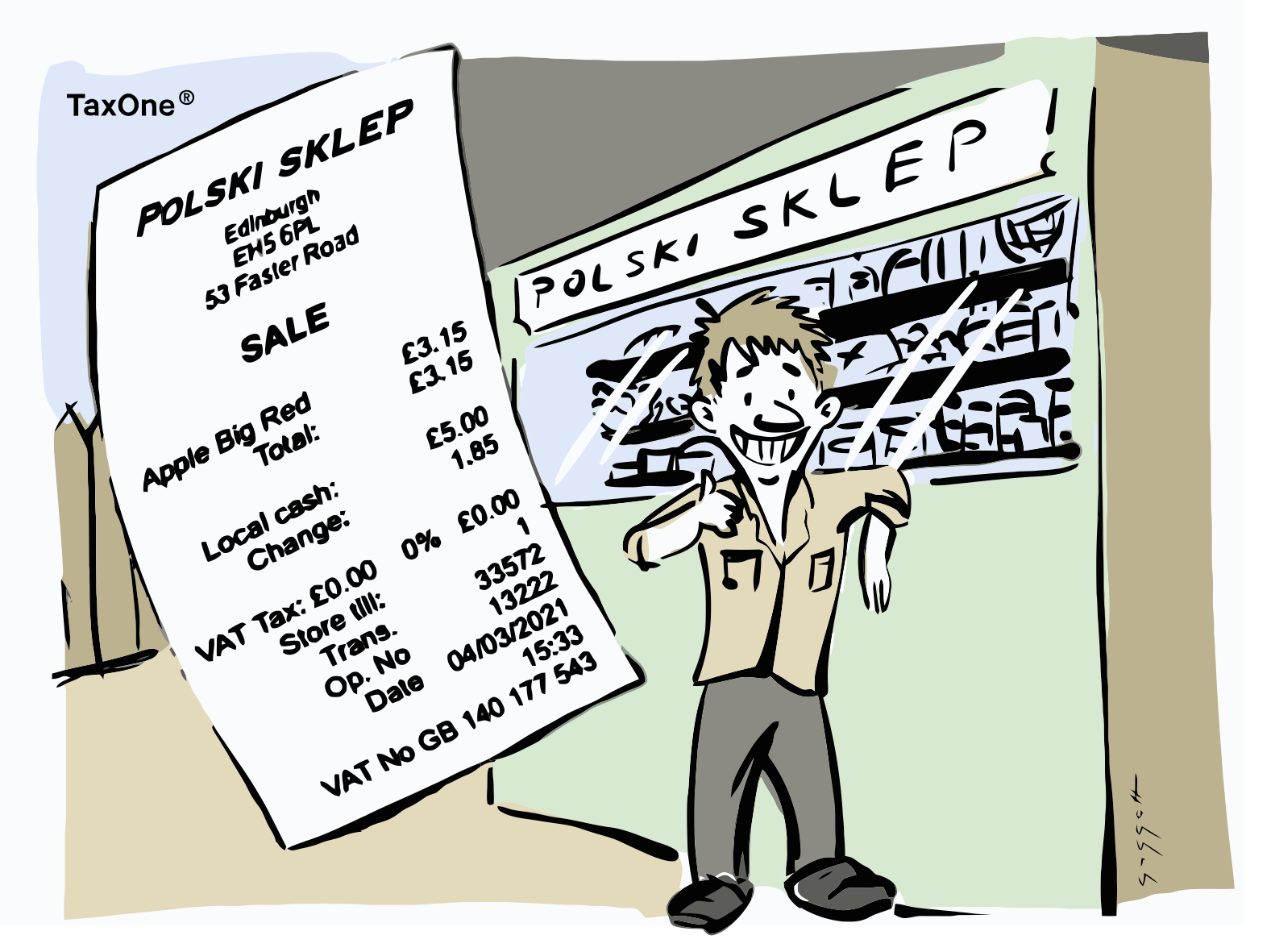
Franek owns a Polish shop and issues invalid receipts! So I started explaining to him how it works and what they should look like.
"Remember that a VAT invoice is the most important document for VAT settlements," I explain, "and if it's 'messed up,' then your entire accounting is 'messed up,' and you'll eventually have to fix it. And that will cost you a lot. Both time, stress, and money. Let's hope you don't get a visit from HMRC before you fix the errors."
It will be easiest for me to describe this using the example of Polish shops, because their owners most often don't know what a properly issued VAT invoice should look like. Often, it's not the shop owners' fault, but rather a lack of information from the accountants who manage their finances.
Different types of businesses may issue different invoices. For example, Polski Sklepik LTD will often issue simplified invoices. Let's start with the general rules, however.
What should be on a VAT invoice?
Information that a VAT invoice/receipt must contain (VAT Invoice) can be found in the 1995 Tax Act. They are as follows:
- a unique invoice number (it must be a sequential number, i.e., 1, 2, 3...);
- date of sale of goods/services;
- date of invoice issue (it may happen that you issue the invoice at a later date);
- your business name and address;
- VAT number (probably the most frequently omitted on all invoices, yet the most important);
- customer's name and address;
- description of the service – sufficient for HMRC to identify whether a given product or service is subject to VAT;
- quantity of the item/service sold, the VAT percentage applied, and the net price;
- total gross amount;
- discount amount;
- VAT amount.
When must a VAT invoice be issued?
When selling services or goods you must issue a VAT invoice within 30 days of the sale.
A VAT invoice does not have to be issued for zero-rated or VAT-exempt services or goods. Remember that there is a difference between ZERO VAT and NO VAT (exempt) – the first still has VAT, it's just zero-rated. The second has no VAT.
If a VAT invoice is issued in a foreign currency, the tax VAT charged must be stated in the local currency (which in our case means in pounds).
Simplified invoice (Retailer Invoice)
If the bill does not exceed £250, the VAT invoice can be in a simplified form. It would be difficult for Franek and Polski Sklepik Ltd, as mentioned in our example, to write the address of the person buying bread and butter on every receipt, wouldn't it?
Polski Sklepik Ltd must meet two conditions to be able to issue a simplified invoice:
- it must be a retailer and sell directly to an individual;
- the purchase value cannot exceed £250 (including VAT).
Therefore, Polski Sklepik Ltd must include the following information on its invoice:
- the business name and address;
- VAT number;
- description of goods sufficient for HMRC to identify the goods (OPEN ZERO VAT, or GENERAL ZERO VAT is insufficient information about the goods for HMRC purposes);
- total gross amount (including VAT);
- for each amount subject to VAT, information must be included on the percentage of VAT charged on it (e.g., if chocolate was sold for £10 including VAT, then 20% VAT must be stated as applied).
Consequences of Incorrect VAT Invoices
The most important thing to understand is that correctly issued invoices are a legal requirement. For them to serve as proof of correct VAT accounting, they must be issued correctly. If they are not, HMRC has the right to impose a penalty on you for what is known as "careless inaccuracy". However, this is not the primary reason you should be careful when issuing invoices.
The most important thing is that you don't want to give HMRC a reason to scrutinize your company's finances more closely. If you can't even manage something as basic as issuing a correct receipt, then the question arises: how many errors are there in your tax returns?
Examples of incorrectly issued receipts
I went to two different shops in Edinburgh and bought various items to check if I would be issued a correct receipt. Neither of them was 100% correct.
The first one doesn't meet any of the required conditions.

- there's the shop's name (blurred by us) but no address;
- there's no VAT number;
- identification of the purchased item is impossible.
If HMRC were to audit this seller, they would certainly face a lot of problems.
The second receipt looks like this:

- no business address;
- no VAT number;
- what we're buying is much better specified;
- there's an item "Various non VAT" – what is "various" and why "non VAT"? If it's a grocery store, it should be "zero VAT" because the items sold are still subject to VAT, just at a zero rate. They are not "exempt".
What a VAT receipt should look like
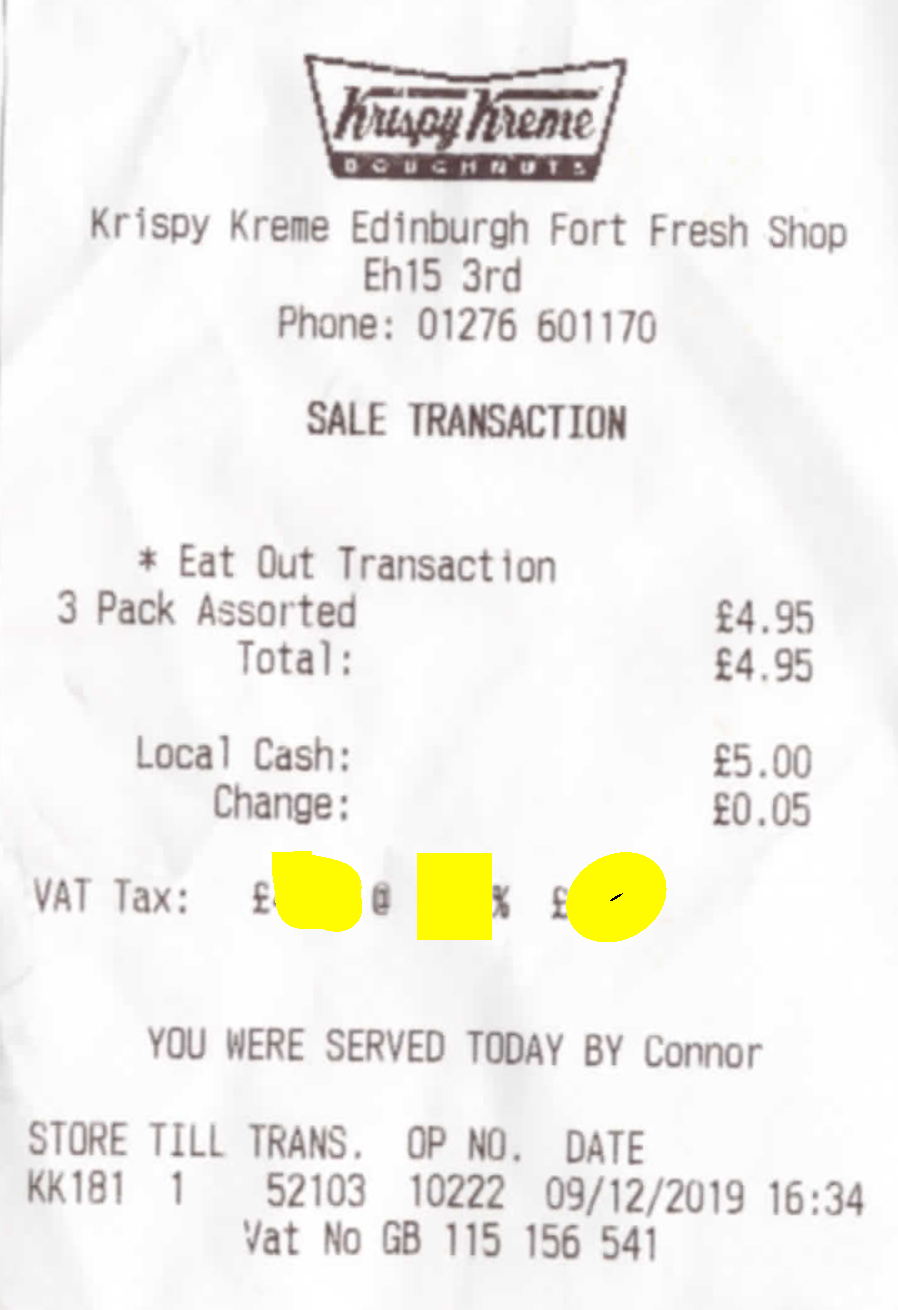
- there's an address - we know who the seller is;
- it's clear what's being served – in this case, a three-pack of doughnuts;
- the net amount, the VAT percentage charged, and the gross amount are itemized;
- at the very bottom of the receipt, the VAT amount and the date of issue are provided.
This is an excellent example of what a UK VAT invoice should look like.


