


HMRC's Big Brother - small business audits

What is IR35?
It is a set of rules, also known as off-payroll, aimed at tightening the British tax system. It applies to situations where actual employment is disguised as a contractor engagement, typically involving a sole trader company providing services exclusively to the same employer. In reality, the services provided are characteristic of an employed individual. Permanent employment involves many additional costs, beyond the salary. These include:
- Employer National Insurance Contribution (NIC);
- paid leave (holiday);
- sick pay (SSP);
- workplace pension contributions;
- Employer Liability Insurance;
- workwear and tools.
For this reason, many small businesses tried to avoid signing employment contracts and instead shifted employee responsibilities onto the "company" working for them. A positive IR35 test result obliges the employer to change the contract, pay overdue income tax and NIC contributions (along with any penalties and interest - HMRC can conduct audits covering a period of up to 6 years retrospectively).
Are you employed or self-employed?
Such a question might be asked by HMRC during a tax audit. It will be difficult to explain to the official why you are invoicing as self-employed while working as a shop assistant or a contract worker on a construction site.
However, this is important for the tax office. As we described above, employing a worker means higher taxes in the form of National Insurance Contribution (NIC) – i.e., social insurance payments. It is therefore not surprising that many employers aim to hire workers on a self-employed basis. After all, according to the Office of National Statistics, employer costs have increased by 99.1% since 2000 and continue to rise – by an average of 3.3% annually. Current average weekly earnings, information on gender pay gaps, and low pay data can be found on this page.
The option of shifting NIC payments, pension contributions, or holiday-related expenses onto the worker is therefore very tempting for employers.
HMRC will check if an employee is engaged under the correct terms
Since 2017, HMRC has been diligently seeking out employers who try to cut corners on employment. This task is carried out by specially trained teams, and HMRC is becoming increasingly effective at it. There were even plans to check financial data in banks and other institutions without the taxpayer's knowledge (Financial Times article on the subject here), but these were not implemented (HMRC's 2018 publication can be found here, and the response from The Association of Accounting Technicians - AAT - here).
Making Tax Digital will assist HMRC with audits
From next year, every self-employed individual and every company will be required to keep all their financial data in a single, HMRC-approved accounting software, such as Xero, which will connect with banks and the tax office to submit quarterly returns (not annually, as was previously the case). This program is called Making Tax Digital (MTD). Therefore, business owner, be aware that once MTD comes into effect, you will be subject to much closer scrutiny (you will also need to factor the cost of purchasing the software into your company budget).
HMRC-trained personnel will audit you
HMRC cannot afford to hire highly qualified individuals to pursue taxpayers, so it employs those without qualifications and trains them in only one type of tax. I once had the opportunity to speak with an HMRC agent auditing VAT in small restaurants. He admitted that he wasn't an accountant or tax advisor by profession, and he had moved to his current job from Tesco, where he stocked shelves. Regarding his education, he had a business degree. However, he was thoroughly trained in two pages of the VAT Act (VATA 1994), concerning sales and the calculation of VAT on food. Legal acts can be tens of thousands of pages long, so training one person in all taxes is difficult. Furthermore, someone with such extensive knowledge would not work as a relatively low-paid HMRC agent. For this reason, each business is assigned a different agent, knowledgeable in one type of tax, but thoroughly educated on that specific subject.
If you deliberately defraud HMRC, you will face a penalty
If HMRC can prove that a taxpayer has committed tax fraud, it will impose a penalty (usually very financially severe) and publish their details (name, surname, and address), as well as the amount owed to the "tax office" and the size of the penalty imposed. This list is updated quarterly. It can be found at this link. It includes people from various professions and specializations: taxi drivers, online sellers, restaurant and takeaway owners, construction workers, dog breeders, small shop owners, and others – anyone who knowingly commits tax fraud and is caught by the authorities. The results of AI-based systems designed to identify tax fraudsters are even sometimes featured on television programs.
Unfair employer practices – check if you are entitled to an employment contract
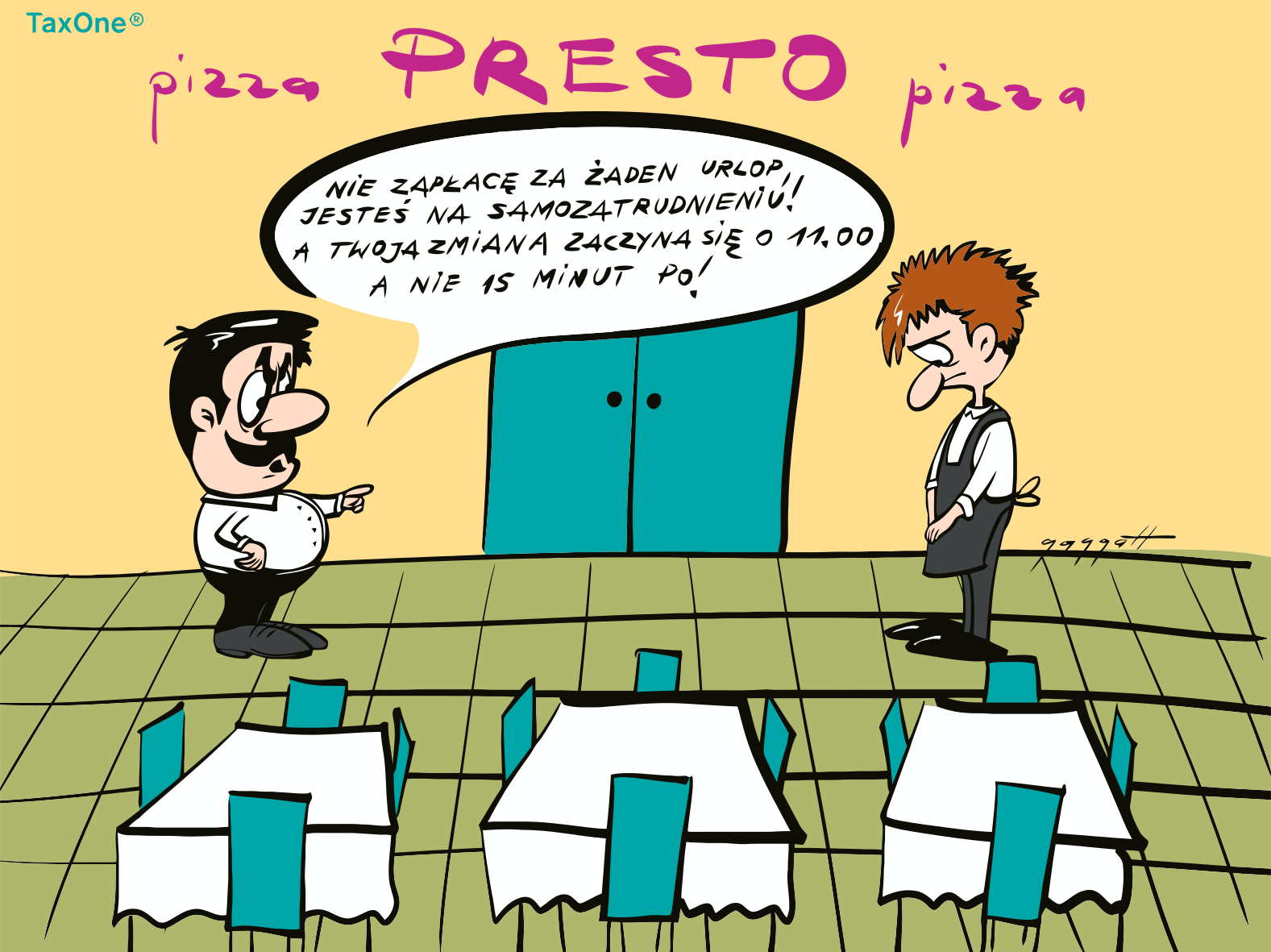
The issue of implementing the correct type of employment is important not only for HMRC. Very often, it concerns individuals who have been wronged by unfair practices of an employer. If you are being forced to issue invoices as self-employed, but in reality, you are working under conditions that indicate employment, you can claim compensation from your employers. I dealt with such a case in 2015 in Aberdeen, where two individuals were unfairly dismissed because they demanded an employment contract. The employer was a pizzeria owner illegally employing people without payslips. A letter demanding compensation was sent to him. The case went to court. It lasted a long time, almost 15 months, but the wronged couple received, by mutual agreement, not only the missing wages but also compensation. The pizzeria owner had to pay the couple £2,000 plus legal costs.
What to do when dealing with an unfair employer in the UK?
The first step is to contact an organization ACAS, which will contact the employer on your behalf, demanding payment of outstanding amounts. If this doesn't help, ACAS refers the case to court. At this point, the employer will likely use their insurance to hire a lawyer. It's crucial that the evidence you possess is irrefutable. My task was to prepare the documentation in such a way that the lawyer had no choice but to agree to a settlement. The employer will be keen on this due to the costs of proceedings, as well as the possibility of their case being publicized, for example, in newspapers. Due to the settlement reached, I cannot disclose the names of the clients or the name of the defendant pizzeria. However, this case clearly illustrates that when you have undeniable evidence that you were indeed employed as a worker, not self-employed, and therefore were misled by the employer, there's a very high chance of winning the case. The law must work both ways, not just in HMRC's favor.
How do you know if you were employed or self-employed?
HMRC determines this based on precedents already established in the Tribunal.
You are considered employed when:
- you do not set the price of your services yourself – they are predetermined (e.g., £7 per hour);
- you cannot send a substitute in your place;
- the person you work for is your superior and gives you instructions;
- you wear the uniform of the company you work for;
- absence from work could lead to dismissal, etc.
You are self-employed when:
- you have a business and manage it;
- you can send anyone to do the work;
- you provide price quotes;
- you issue invoices for more than one person or company, and for related individuals and companies;
- you finance the business yourself;
- you can work for more than one person at the same time;
- you buy your own tools and business assets, etc.
You can find details on this on this HMRC page.
Each case is considered individually by HMRC. However, if you feel the work should be performed under an employment contract, that's usually the case.
Among recent cases decided in favour of employees: in February 2021, the Supreme Court issued a landmark ruling, which confirmed that Uber drivers are employees, not independent contractors. This means Uber drivers are entitled to pension contributions and holiday pay – but they can still choose when they work and remain self-employed for tax purposes. Additionally, HMRC has launched another tax investigation into unpaid VAT. Uber will therefore have to pay millions of pounds to its drivers, as well as for unpaid National Insurance Contributions, "minimum wage", and VAT. More on this in Financial Times articles.
If a company as large as Uber loses a case in court, a shop assistant or a construction worker is even more likely to win theirs.
The conclusions are therefore as follows:
Employers, hire people working in your shop on an employment contract. Employees, register as a contractor and sub-contractor with HMRC, and do not issue invoices as self-employed. If in doubt, seek advice from a tax advisor.
The responsibility lies with you. HMRC will prove your illegal activity, and you will bear the consequences, even if you acted on the advice of your accountant.
Let's also try not to cheat on taxes – there are legal ways not to pay them, or to pay significantly less.


