


VAT – when does it apply to your business?

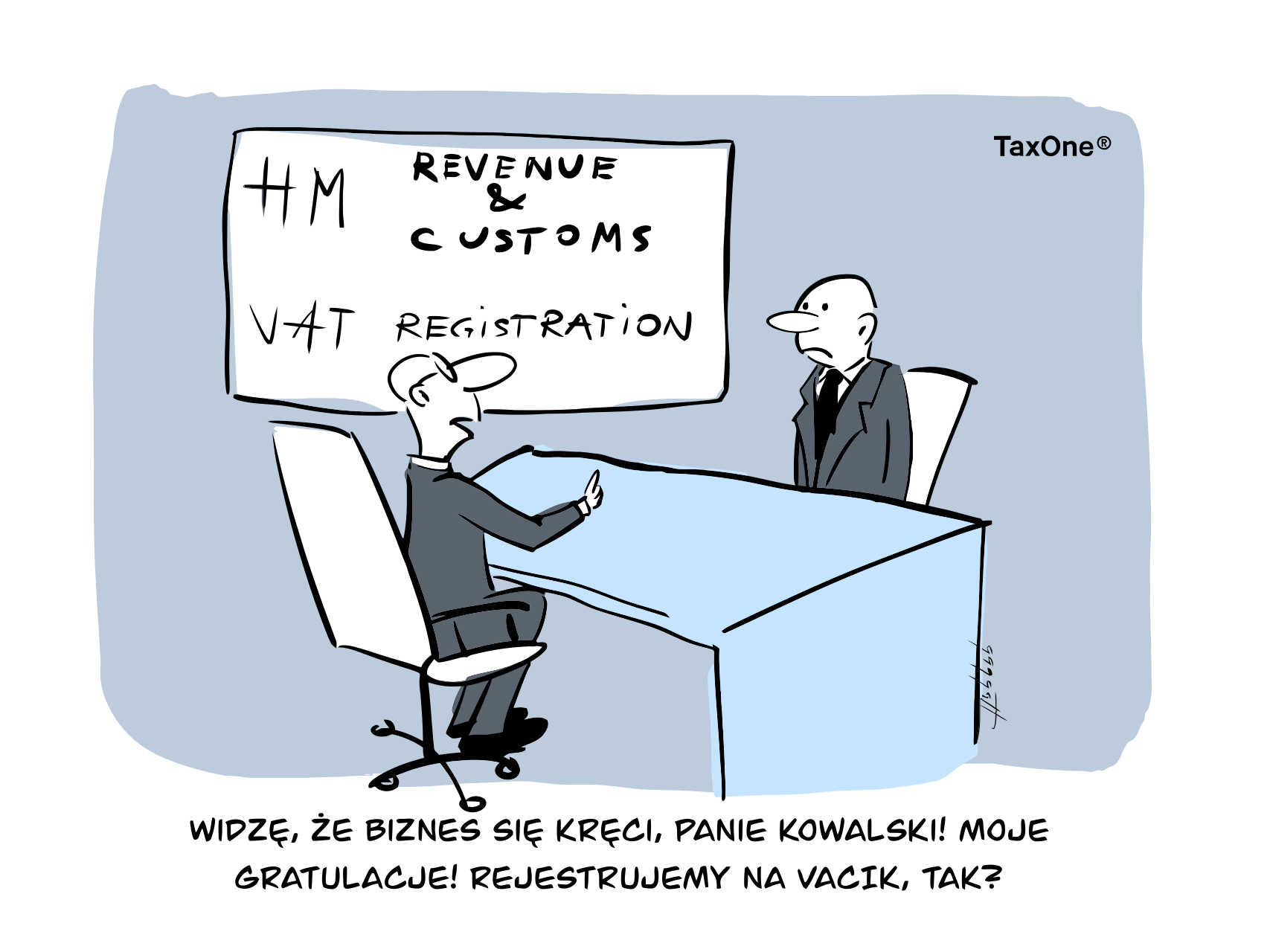
When are you required to register for VAT with HMRC, and what are the penalties if you don't? That's our topic for today.
Marek operated a cleaning services business as a self-employed individual. He employed over a dozen people. After some time, it became clear that his income was hovering around the threshold, known as annual registration threshold, which is £85,000. Once this amount is exceeded, the business owner is required to register for VAT within 30 days.
Marek's accountants, who calculated his taxes, advised him to set up an LTD company (limited), which is a separate legal entity, and to split the income between his self-employment and this new company, thereby avoiding VAT. Marek followed his accountants' advice. The self-employment business handled private clients, while the limited company dealt with businesses. As was later discovered, both companies were hovering just below the VAT threshold.
When the tax authority audited his self-employment, it was discovered that Marek had been fined over £20,000 for deliberate tax evasion.
Artificial splitting of business activities
Many errors were made in this situation. However, the primary mistake, which HMRC treated with such severity, was that the Ltd company was established with the deliberate intention of avoiding VAT.
Splitting a business in the manner Marek did is against the law, specifically against the Value Added Tax Act 1994, as amended. According to this regulation, if businesses are linked personally (through the individuals operating them), financially, economically, and organizationally, the division of activities is considered artificial and deliberately undertaken by the taxpayer to avoid taxation.
Such conduct is always treated with great severity by the tax authority, resulting in substantial financial penalties and the publication of the individual's details on the list of deliberate tax evaders, which is updated every three months.
HM Revenue and Customs issued a document called Statements of Practice 4, which explains how regulations aimed at preventing the artificial splitting of businesses will be applied to enable them to operate below the VAT registration threshold.
Therefore, in the presented case, Mark's company should never have been split and should be registered and accounted for under a single VAT number, because "one person has controlling influence over a number of entities, all of which provide the same type of supplies in different locations."
The case of DB Jones & Co
Situations like the one described in this article already have legal precedent: in the case of HMRC v DB Jones & Co (16796 Jones (t/a DB Jones & Co) [2001]BVC 4041), the tax authority won a case to recognize two companies, performing similar work and belonging to a single entrepreneur, as one enterprise.
Mr. Jones, as an accountant, operated a self-employment business registered for VAT and was also the sole director of a Ltd. company, which also dealt with accounting but was not VAT registered. The companies were registered under different names and had separate bank accounts.
The court found that there was no doubt that the two businesses in question, which have a single owner and conduct the same type of activity, are in fact one enterprise and should be accounted for as such.
When should a company start accounting for VAT?
This is an issue that many entrepreneurs and, unfortunately, many accountants misinterpret.
Calculating whether the annual financial threshold (annual registration treshold) has been exceeded does not apply to the tax year, but to the last twelve months of activity.
Every entrepreneur is obliged to check monthly, by summing the company's turnover obtained over the last 12 months, whether this threshold has been exceeded.
Legal regulations regarding VAT registration can be found in the Value Added Tax Act of 1994, as amended, in paragraph 2.
VAT Deregistration and its Consequences
If there are "reasonable grounds" that the company's turnover will not exceed £83,000 in the next twelve months, then we can deregister from VAT. We have 30 days to notify HMRC.
It should be noted that if any fixed assets were purchased while the company was VAT registered, and VAT was reclaimed on them, then after deregistration, we must also return a portion of the VAT. For accurate calculations, it is best to go back to the point when the company started accounting for VAT. The requirements for deregistration are set out in the Value Added Tax Act of 1994, as amended in paragraph 3.
Flat-rate VAT scheme
VAT can also be accounted for using a flat-rate scheme, based on the rate specified for particular types of activity, but in this case, you are not allowed to deduct input VAT from purchase invoices. The tax at the required rate is paid to the tax office, but invoices for clients are still issued with an added twenty percent VAT rate.
Flat rates for specific types of activity are detailed on the government website, which you can find here.
Important! According to the Tax Management Act, the tax office can audit a company's finances up to six years back from the end of the current tax year.
Avoid unreliable accountants
From the facts of the case, it is clear that the unreliability of the individuals who undertook Marek's company's accounting services played a major role in the violation of tax regulations, for which he was severely financially penalised. Marek is therefore entitled to a tort claim against his accountants.
The expense in the form of a fine and interest for the overdue VAT should be covered by their Professional Indemnity Insurance, which every professional should have in case a client suffers financial damage due to poorly performed services.
It should also be noted that in Marek's case, there is no chance of appealing HMRC's decision, because to do so effectively, one must have a "reasonable excuse." According to the list of excuses considered reasonable by HMRC, it is not possible to explain tax irregularities to the tax office by arguing that they resulted from relying on a third party.
How to find a reliable accountant? First and foremost, you should check if they are a member of a professional body that brings together individuals with appropriate qualifications for their profession.
The UK does not have legally defined requirements for accounting and tax advisory services, so it is very easy to encounter someone offering such services without the proper qualifications. We have already made a separate video on this topic, which can be found here.
Check out the video below on today's topic!


